
Michael Guy LEO Master Routine – The Birth of Software Engineering?
Michael Guy joined LEO straight from Wadham College, Oxford in 1962 with a
mathematics degree. After two years working on the Master Routine he left to do a PhD
at Newcastle University in integer programming. After two years working for Wiggins
Teape in their systems development department he rejoined what was then ICL. He
worked on VME for many years, progressing from programmer to designer, project
manager and OSTECH. When a team was created to pursue the UK Alvey projects,
launched as a response to the Japanese 5th Generation project, he seized the opportunity,
working mainly on persistent programming with the universities of Glasgow and St
Andrews. He ended his career with Teamware in what had become Fujitsu. On retirement
he went back to university, taking degrees in theology and biblical studies at Birmingham
University. After gaining an acquaintance with at least a dozen programming languages
he had no desire to program any more until twenty years later, when he found himself
helping to debug his grandson’s Python programs on a Raspberry Pi.
I worked on the LEO III Master Routine from 1962 to 1964, going straight from
university with a maths degree. It was nearly sixty years ago and my memories of that
time have been paged out and archived, and have probably been corrupted on the way.
Also I do not have a wide knowledge of the wider world of computing at the time. But I
have been encouraged to write this article in the hope of generating discussion of a very
important subject – the development of the discipline of software engineering.
John Daines writes “I have listings of the master routine and it was written in Intercode.
Intercode itself was a level above machine code and, although a instruction looked to be
an equivalent to a machine code instruction, it was often expanded by the translator
into several machine code instructions.
However, Intercode instructions 100/0/0 to 131/1/3 were one for one equivalents of
machine code instructions 0/0/0 to 31/1/3. That meant that the master routine
programmers could program at the lowest level and use specialist low level instructions
that weren’t in the Intercode set e.g. input output, interrupt handling, setting store
protection tags .etc
Interestingly, Cleo allowed for routines to be written in Intercode and, by implication
from the above, that Intercode might include machine code.”
LEO was the first computer to be used for business purposes. This meant a change in the
priorities of computer design. The first change was that it was used for data processing. It
spent relatively little time actually calculating and a lot of time reading paper tape,
printing and reading and writing magnetic tape. The role of the Master Routine was to
manage the computer efficiently and attempt to keep everything going full time. This is
what multi-programming is about

Michael Hancock I was Shell Mex and BP’s chief programmer when we acquired our
first Leo III in 1963 (no 6) and was involved in the studies and decisions which led to its
acquisition. We later acquired another Leo III and 2 Leo 326’s which were considerably
faster. Our computer centres were in Hemel Hempstead and Wythenshawe. Leo were in
competition with ICL and IBM and succeeded first because they had the most suitable
machine and second because of their skill in persuading our management that they were
right for the job. ICL had a grand machine on the stocks then but typically, it never saw
the light of day. I designed a massive sales accounting system with help from John Aris.
Such a pity that Leo did not have the resources to create the next generation. I was lucky
enough to be in another area while a traumatic transition to Univac took place.
The Leo users group brought me into contact which such as Dunlop and Imperial
Tobacco. The latter was worth a visit to Bristol as they gave away a box of cigarettes to
their visitors. An extended version of the career and memoirs is available in Dropbox at
https://www.dropbox.com/s/22dwf6tv7cid0ui/Mike%20Hancock%20Memors.docx?dl=0
Douglas Hartree and LEO (from Wikipedia
https://en.wikipedia.org/wiki/Douglas_Hartree)
Hartree’s fourth and final major contribution to British computing started in early
1947 when the catering firm of J. Lyons & Co. in London heard of the ENIAC and sent a
small team in the summer of that year to study what was happening in the USA, because
they felt that these new computers might be of assistance in the huge amount of
administrative and accounting work which the firm had to do. The team met with Col.
Herman Goldstine at the Institute for Advanced Study in Princeton who wrote to Hartree
telling him of their search. As soon as he received this letter, Hartree wrote and invited
representatives of Lyons to come to Cambridge for a meeting with him and Wilkes. This
led to the development of a commercial version of EDSAC developed by Lyons, called
LEO, the first computer used for commercial business applications. After Hartree’s death,
the headquarters of LEO Computers was renamed Hartree House. This illustrates the
extent to which Lyons felt that Hartree had contributed to their new venture.
Hartree’s last famous contribution to computing was an estimate in 1950 of the
potential demand for computers, which was much lower than turned out to be the case:
“We have a computer here in Cambridge, one in Manchester and one at the [NPL]. I
suppose there ought to be one in Scotland, but that’s about all.” Such underestimates of
the number of computers that would be required were common at the time!
Presentation Friday 26 April, 2024 at 17.00 BST by Andrew Herbert on the EDSAC Rebuild at TNMoC. A recording is available here Zoom Recording.
Andrew commented the following in the abstract.
While EDSAC can justifiably claim to have been ‘the world’s first practical digital electronic stored program computer’, as is well-known to the LEO community, Pinkerton, Lenaerts and colleagues had to address many of the ‘inadequacies’ to produce in LEO a robust machine that could take on the information processing needs of the Lyons company and be the world’s first successful business computer.
Andrew Herbert: The EDSAC Rebuild at TNMoC Read More »
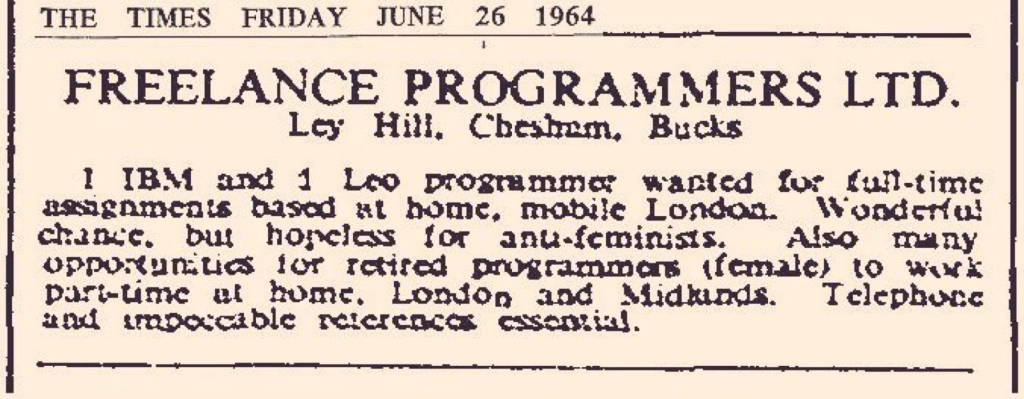
In 1964 the inimitable Dame Stephanie ran this advert in The Times, seeking programmers for her startup. “Ant-feminists need not apply”-plus opportunities for women who’d retired
Marie Hicks Twitter Message: Read More »
Denis Hitchens. Operator on LEO III/15 at Shell Australia
Neil Lamming interviewed me and conducted the aptitude test. But the person I was
really trying to dredge from my memory was Bill Cheek who along with Jack Dankert
encouraged me to return to full-time study. I was 19 and 20 at the time, turning 21 about
a fortnight before I went to RMIT — imagine a 20 year old shift leader with the fate of
SCO in his hands!! So for me as a whippersnapper training 35+ year olds was a life
defining experience and one which a bit later in life when I was President of the Students’
Representative Council (elected leader of some 12,000 students) I was able to refer to
when addressing Melbourne Rotary ( yes, all the big wigs). A fuller version of the
reminiscences are available in the LEO Dropbox archive at
https://www.dropbox.com/s/bqgrbhxh9cp4s4k/Denis%20Hitchens%20Reminiscences.docx?dl=0
Brian Hobson: I am glad that you, (Hilary Caminer), were able to attend our recent
“LEO do” as chaotic as it was! You asked if I would explain the origins of our group and
also to help you understand our Lyons/LEO relationship as it seemed rather confusing.
I will do my best. The meeting started when Norman Beasley retired from Lyons
in/around 1982. Norman had been a member of Lyons/Leo from the early days and was
Operations manager on LEO 1, LEO II/1, and LEO III/7 before becoming Computer
Consultant to the Lyons group of companies.
Norman lived in Chalfont St Giles (I think this is correct) and Peter Bird (Lyons
Programming Manager) and Alex Tepper (Lyons Operations manager) would go to visit
him fairly frequently. Carol Hurst, who was at our meeting, also lived nearby and had
also left Lyons would join the others making a foursome. In my Lyons career I started in
Operations as an operator (employed by Norman) and later became a consultant working
with Norman. When Alex Tepper was promoted to Head of Computing for Lyons I
became Operations manager and joined the gathering.
All Lyons computer staff are quite a close knit group and various members moved into
senior positions within other companies within the group as Accountants or Head of
Computing, etc. Tony Thompson, who you met, became Chief Accountant for various
companies, Alan King (now passed away) became head of Lyons Maid computing. They
joined in our meetings and gradually as time went on our group has continued but with
varying members, as old ones passed away others came to know of us and joined. Peter
Bird was the mainstay organiser as he had the most contacts. Cyril Lanch is a fairly
newcomer to our group but did not step back quick enough when volunteers were sought
to carry on Peter’s organising! Hopefully that explains our group, now for the
LEO/Lyons feelings – difficult!
History of Lyons and computers. Lyons built a computer to do work for Lyons Electronic
Office (LEO), staff working on the computers were Lyons staff. With the success of
computers Lyons formed a computer company LEO Computers Ltd but the staff although
working for LEO were still Lyons staff at heart. When the company LEO was sold the
computers remained at Lyons and were operated by Leo staff until they chose to remain
at Lyons or were replaced by new Lyons staff.
Lyons computer history goes from LEO I through Leo II/1, LEO III/7, LEO 326/46 and
eventually to IBM computers. Our attachment to LEO may be explained by the fact that
the original computers were still in use at Lyons long after LEO had been sold and in
many instances the staff working them were the original staff. When LEO was sold the
computer department became LEO and METHODS, then Lyons Computer Services Ltd
(LCS My best analogy would be: If you had a daughter and she got married she would
still be your daughter and a member of your family although she would have joined
another family, you would continue to be proud of her. The same is how our computer
department feel.
When LEO was sold the computer department became LEO and METHODS, then Lyons
Computer Services Ltd (LCS), and finally Lyons Information Systems Ltd (LIS).
As you may now gather we were very proud of our heritage but so was the computer
industry. We as a Computer Bureau (which we had been from day 1 of computers)
strived to continue to be at the forefront of computer usage and computer and peripheral
manufacturers were very keen to be associated with us offering us very competitive deals
to use their equipment. Our computer department was frequently put under the
microscope by the main Lyons Board as the newer family Board members felt that
computing was expensive but on every occasion the auditing companies, including IBM,
were in awe as to how we are able to do so much with so little and still lead the
world. An example of this was back when Lyons had a fire on the Xeronic Printer in the
LEO III/7 computer room. We made an arrangement with the Post Office (as it was then)
to use their LEO III (overnight) in Charles House which was just across the road from
us. Our shift of 6 operators replaced a shift of 20+ operators.
I cannot remember the trade magazine that did a piece on us as we were the first company
to wire an entire building with various departments on different floors to use Local Area
Networks linked into the mainframe. Also, one of our external customers was a large
American personal tax company which had a large computer centre in the States but
wanted a worldwide centre based in London. We installed a duplicate of their system
onto our computer, they provided no computing staff as all maintenance etc. would be
done from the States we only had two user/managers with us. Their system was difficult
for their users to manage and I spent a lot of time supporting them because of the
complexity of their system.
Eventually I volunteered to improve it for them and wrote a few simple programs
and restructured their system making it much more efficient (saving hours a day of
machine and their input time). The computer staff in America were interested in what I
had done and came over to see for themselves, they were amazed and the CEO asked
permission to adopt our version of their system to replace their own!
My own involvement with Lyons started while I was at school. My brother, Colin, whom
you met was an operator at Lyons on LEO II/1 (but employed by LEO Computers) and I
used to go with him to work some evenings or when I was not at school. I was able to
help operate the LEO II computer (unofficially of course) and met the engineers on the
LEO III/7. When Colin moved to Hartree House I also used to go there as well and
helped out on the LEO III installed there. I loved the job and it really appealed to me so
when I left school (in 1966) I went for interviews at Lyons and ICT (as it was
then). Norman interviewed me and offered me the job (it helped that I knew several of
the staff by name which impressed him!). I worked my way up from trainee operator to
Ops Manager until the closure of the company in 1991. I won’t bore you with my life
history of the roles I held and of the changes in company structure that I made over the
years as most of this was during our IBM period.
I hope that this gives you some insight into our little group and our attachment to LEO
and why we feel a little side-lined when at the LEO Computer Society gatherings Lyons
seems to be irrelevant. Maybe that is changing now but at the few meetings I went to
over the years that is how it seemed which is why I have never bothered joining
Colin Hobson: Weather, Wildlife and LEO Computers
Both LEO 1 and the LEO 2s were not installed in cosy, air-conditioned palaces. They went
into normal office accommodation and the heat, generated by the hundreds of thermionic
valves was conducted away by fans and overhead ducting. The operators were kept cool
only if they could open the office windows! This could cause a number of unexpected
problems:
On LEO 1 rain could be a problem. It was necessary to look outside before turning
anything on. If it was raining, or snowing, the heaters in the valves needed to be turned on
before the cooling fans. This built up enough heat to ensure that the water droplets sucked
in were vaporised before they hit a hot glass valve cover. Failure to do it this way round
would result in a series of high pitched squeaks as the glass, of the valves cracked. This
would be followed by the sound of engineers swearing! If there was no rain, it was better
to get the cooling up and running first.
On LEO 2 this was not a problem. The ventilation system didn’t cause the computer much
in the way of problems. The computer did provide a lot of heat, most of which was
conducted away by the ventilation system. However, there was still a lot of peripheral
equipment and human bodies churning out heat. The only option, certainly on LEO 2/1 was
to open the windows to the outside world. Mostly this worked well. However, there were
times when the outside world made its way into the operating area to cause chaos. Wildlife
was one such problem. The occasional visiting bird could provide some distracting
entertainment but the worst problem I can remember was a swarm of small insects which
came in through the open windows and settled on the paper tapes and punched cards. They
got squished into the holes in the cards and tapes changing the data.
Many years later I was working at a Post Office (now BT) site where a snake made its way
through one of the doors from the outside world, down a short corridor and then got stuck
between the automatic airlock doors into the air-conditioned computer hall.
Colin Hobson adds I was worked on LEO 1 and subsequent machines but am not sure
about recordings. LEO 1 certainly did make a noise but I have a vague recollection that
the speaker was not in the original hardware but in the dexion operators console, which
was a later addition.
LEO 1 was on a platform at one end of the room (hall). There was an engineer’s console
up there which the operators did not use. The dexion operators console was down on the
parquet flooring along with all the peripherals. The peripherals were aligned in two rows
with shallow metal cable runs going back to the main frame platform. The room was not
air conditioned and at times it was necessary to open several windows to allow the
operators to breathe! A warm wet day was a real problem as we had to make sure the
heat in the room was enough to evaporate the rain before we could open the
windows! Another side effect, on the operators, was the smell of cooking which often
wafted up from below!
Note: Colin Hobson was interviewed by Marie Hicks for her book Programmed
Inequality (see above) and provides one of her case studies noting the story of LEO
David Holdsworth – I went to state schools in the then West Riding of Yorkshire, where the Director of Education was Alec Clegg, well-known for his left-wing views. As a result, I left a co-ed comprehensive school in 1961 and went on to read Physics at Oxford University following a few months working in the works laboratory of English Electric. I began my computing career as a physics research student writing Algol60 programs modelling quarks on a KDF9. After discovering that I might be better at computing than physics, I got a job at Leeds University in 1967 where we implemented the Eldon2 multi-access operating system on KDF9, which was still running at NPL in 1980. Leeds University’s KDF9 was succeeded by an ICL 1906A where I was involved with George3 and George4. At Leeds I was an early champion of Amdahl and of UNIX.
I was often helping others with their computing issues. After completing the doctorate, I went to a job in the Electronic Computing Laboratory at Leeds University, where I worked in a variety of roles until 2004. Actually the thesis was written up while at Leeds. My developments on their KDF9 are documented in Resurrection, the journal of the Computer Conservation Society. Suffice to say that I was a key figure in implementing the Eldon2 multi-access system, which enabled us to offer interactive computing from March 1968, with 32 tele-types connected via a PDP-8.
I started resurrecting/preserving software in the late 1990s. By resurrecting/preserving I mean getting the software into a modern digital state and providing the ability to execute it. George3 was the first such rebirth, using the official George3 issue magnetic tapes, followed by the BBC micro’s Domesday Project. The first software rescued from printer listings was KDF9’s Whetstone Algol. I was also involved in the preservation of digital material that is not computer software. An important principle of my work has been that emulation should work on a wide range of current hardware, with a view to working on future systems. Sometime around new year 2013, John Daines asked if I could use my skills in software resurrection on the pile of listings of Leo III Intercode that had been collected by Colin Tully. After resurrecting software for 1900, BBC micro and KDF9, I was keen to try rescuing software from a machine of which I had no prior knowledge, so as better to appreciate what we need to preserve if future generations can comprehend early machines. I was delighted when John Daines asked me if I could resurrect the Intercode system that he had obtained from Colin Tully’s widow. I immediately put my work on the Edinburgh IMP system on the back burner, where it resides to this day.
I came to Leo III expecting to find an assembly language and set about implementing Intercode treating the printout as the source text of an assembly language. It soon dawned on me that there were no labels, and that really I was dealing with a machine code for a fictitious machine, a sort of Leo IV.
The raw machine code also came as something of a surprise, devoting all sorts of complexities to computing with a variable radix, and using sign-and-modulus for information in the store but converting to 2’s complement in the A register (but not the B register). A step-by-step account of my voyage of discovery which led to a working Leo III emulation is here.
I am fascinated by Intercode, as I think it may offer a window onto the time when assembly languages were emerging, a time before my own entry into computing, perhaps via a privileged side entrance. Seehttps://www.dropbox.com/s/g2ullpu7ooxwvya/David%20Holdsworth%20Memoir.docx?dl=0